


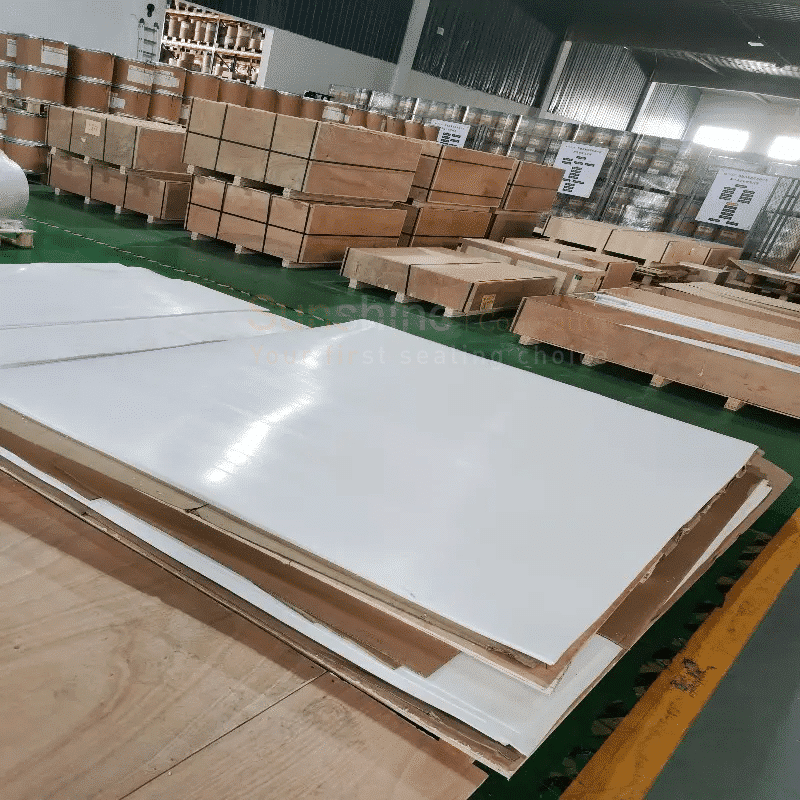
By reading the following content, you will gain much knowledge and information about PTFE sheet.
Welcome to Know PTFE Sheet
PTFE sheet is ideal for gaskets, seals, and other high-lubricity applications because of its exceptional chemical resistance and low friction. It is widely used in electronic, industrial, and aerospace applications due to its excellent electrical insulation and thermal stability properties. For PTFE sheets, we can offer the best price and service.
Method of Production
The two most popular manufacturing processes for PTFE sheets are molding and skiving. .
Molded PTFE Sheet
To produce the molded PTFE sheet, PTFE resin powder is compressed under high pressure and then sintered to create a solid sheet. Compared to a skived sheet, it is more impact resistant and has a higher tensile strength. However, because of the extra manufacturing step, it is more costly.

Skived PTFE Sheet
Using a cutting machine, a round PTFE billet is skived to create a PTFE sheet. Thinner sheets with a smooth surface are the result of this procedure. In comparison to molded PTFE sheet, it has a lower tensile strength and resistance to impact.
The Advantages of PTFE Sheet
For applications requiring low friction and high temperatures, PTFE sheet is an excellent material. It can be utilized as a material for printed circuit boards due to its exceptional dielectric properties.
The coefficient of friction of PTFE sheet is the third-lowest of any known solid material. It is one of the most thermally stable plastic materials, displaying no appreciable decompositions at 260 °C and retaining most of its properties.
The parts made from PTFE sheets can have a longer service life and save you costs. As it is clear that longer-lasting, higher-performance parts can add to the efficiency of any machinery and reduce the need to constantly acquire replacement parts, both saving money and the time needed to fit the replacements, as well as reducing waste.
Applications
Owing to its low friction, PTFE sheet is used for applications where sliding action of parts is needed, such as plain bearings, slide plates, etc. In these applications, it performs better than nylon and acetal and is comparable to UHMWP. Because it complies with FDA regulations, it is also a well-liked choice for food and pharmaceutical processing applications.
Standard Grades of PTFE Sheet
PTFE sheets can be the following types:.
Virgin PTFE
It is made from pure PTFE resin, without any fillers or additives. And it has excellent thermal, chemical, and electrical-resistant properties.
Modified PTFE
Different materials are combined with PTFE powder, which serves as a filling and improves the quality of the gasket. For example, silica filling, barium sulfate, and glass microspheres.
Filled PTFE
Because it is highly flexible, PTFE can creep and deform under heavy loads. This potential disadvantage can be obviated by adding a filler to benefit from the properties of both materials. Fillers can also add properties such as improved thermal conductivity for applications that demand good heat dissipation. The most common filler material is glass, and other alternative additives include carbon, graphite, stainless steel, molybdenum disulfide, bronze, ekonol, and polyimide.
Typical Properties of Pure PTFE Sheet
| Properties | Test Methods | Unit | Value |
|---|---|---|---|
| Density | ASTM D792 | g/cm3 | 2.25 |
| Tensile strength | ASTM D638 | psi | 1500 - 3000 |
| Flexural modulus | ASTM D730 | psi | 72000 |
| Water absorption | ASTM D570 | % | 0.005 |
| Coefficient of linear thermal expansion | ASTM D696 | in/in/°Fx10-5 | 8.9 |
| Coefficient of friction (dynamic) | 0.1 |


